
Is there an 80/20 rule for SEO?
A reader of our Demystifier newsletter sent this in after I asked the list for questions:
Is there something like the 80/20 rule for SEO? So maybe 80% of SEO benefits are attained by writing good material with the right keywords on your website. Maybe 80% of the benefit is my link building, or maybe 80% of the benefit is simply having all the technical aspects of your site perfect. Or maybe 80/20 isn’t relevant to SEO and you need to do it all.
The short answer: yes, there is.
But it doesn’t work quite the way you might think.
By the end of this article, you’ll know precisely how to use this rule to your advantage.
How does 80/20 apply to SEO?
You could list a hundred SEO tasks, and perhaps only 20 of them produce the results. Spend a hundred hours and maybe twenty were time well spent.
That’s the rule. For a small business, this can change everything.
Note that link building is a world of its own, and a bit of a minefield. For most small businesses, ignore link building for now, at least until you’ve done the basics below.
The bit that actually helps
Before we dive in, let’s inject a little realism here.
Unless your full-time job is devoted to SEO, you’re not going to work your way through a list of fifty Google things.
Why? Because your SEO is probably one line on a very long to-do list. And I doubt it’s even in the top ten.
So the real question isn’t “what could or should I do?”
It’s more “if I only do one thing, what should it be?”
Do the first thing.
If it goes no further, you’re better off than you were before.
If or when you have more time, you can do the second thing.
Most people won’t get past the first two, but there’s still progress.
So here’s the order I’d give you.
1. Set up your Google Search Console account.
If you do nothing else, do this.
Set up your Google Search Console account, preferably at the domain level.
It should take no more than a few minutes.
Why should you bother?
Because it’s the most useful free SEO tool you have, and all subsequent tasks depend on what it tells you.
The rest of this list takes different amounts of time. This one is incredibly quick to set up.
If you already have your account set up, maybe have a quick look at Google Search Console Vitals.
Quick actions:
- In Performance, Search results, switch to “Queries”, add a filter for Average position ≤ 10 to find low-hanging terms.
- In Indexing → Pages, have a look at “Crawled – currently not indexed” and “Discovered – currently not indexed” for important URLs.
2. Do proper keyword research with a decent tool.
You might think you know the terms people use to find what you sell.
But if you haven’t used a decent keyword research tool then you probably have no idea.
And watch out for the common keyword blunders.
Over the years we’ve worked with too many keyword tools to name, but right now, we’re happy with Mangools.
If $38 a month seems too much, you may be missing the point.
Even though you know your product, features and markets better than anyone else, it’s impossible to guess the words people type to find what you sell.

On top of that, two terms can look almost identical, yet one gets far more searches, or has a fraction of the competition.
This is impossible to guess or judge.
Guessing is how good content ends up aimed at nobody.
Quick actions, using your keyword tool of choice:
- Build a list of the top 10-20 keywords that you’d like to get clicks for
- Check where you actually rank for each
- And where you don’t show up at all
If nothing else, this can be helpful for when you write future content.
3. Fix the (genuinely) low-hanging fruit.
Search Console can show you the terms where you already rank between positions four to ten, for example.
A little basic filtering, and you’re looking at relevant terms, with a significant number of impressions, sitting just off the top of the first page.
Nudging a page from position six to four is potentially achievable.
Improving it from position 15 to four is more difficult.
So start where you’re already close.
Quick actions:
- In Performance, filter Average position 4–10 and impressions above a sensible threshold for your niche
- For each candidate page, update the title and/or H1 to align with the winning query, add a concise section that addresses the term, and add 2–3 internal links from related pages using descriptive anchor text
- Re-submit the URL for indexing and review in 4 weeks
4. Make sure the pages that matter are crawlable and indexable.
A crawlable page is one that Google can read.
An indexable page means that they can store it so that it shows in the search results.
Ideally, you want almost every page on your website to be crawlable and indexable.
But initially, at least, you should focus on the main pages.
The pages you want your visitors to see.
Your home page, your main product or service pages, your about page. Your blog.
These should also be easy to identify.
A few internal links, used sparingly, can fix most of these issues.
And like all the best SEO techniques, this will be good for your visitors and for the search engine spiders alike.
Quick actions:
- Check Indexing → Pages in Search Console: fix unintended “noindex” and soft 404s
- Make sure important pages are linked from the main navigation or within a couple of clicks from the homepage
- Avoid orphan pages; add at least one contextual internal link from a relevant page
5. Get the on-page basics right.
I’m talking about the most basic principles of SEO.
Make sure that your page titles are optimised – but not overly so!
Your meta descriptions. They won’t improve rankings, but a clear benefit and a call to action can improve click-through.
And use internal links to related content.
Within reason.
Remember the SEO golden rule: None of this matters if the page makes no sense to a human.
Write for the reader, then optimise. Not the other way around.
Again, initially at least, you can focus on the main pages.
Quick actions:
- Check your page titles and H1s.
- Use descriptive, not keyword-stuffed, anchor text for internal links.
- Fix duplication and thin (low quality) pages before publishing new ones.
6. Fix performance, but only where it’s broken.
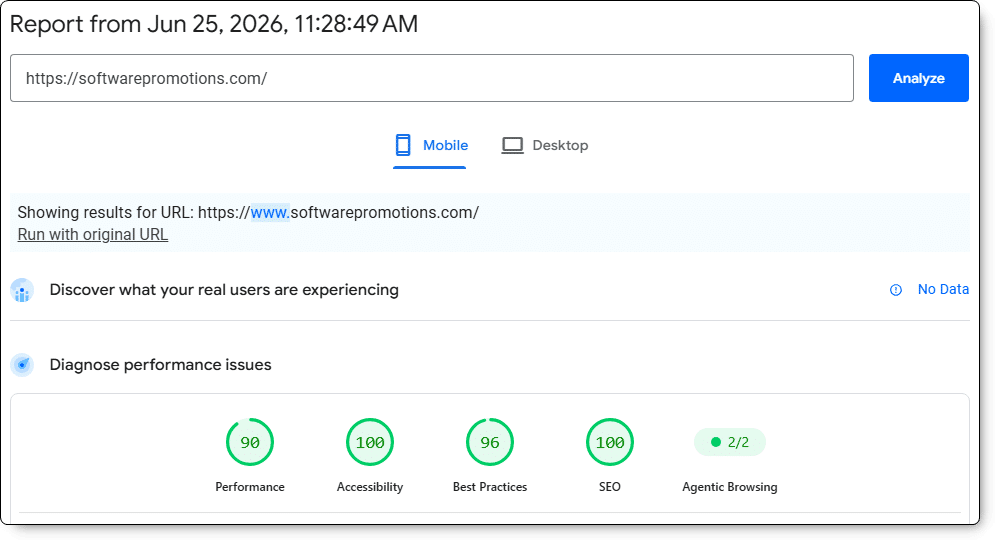
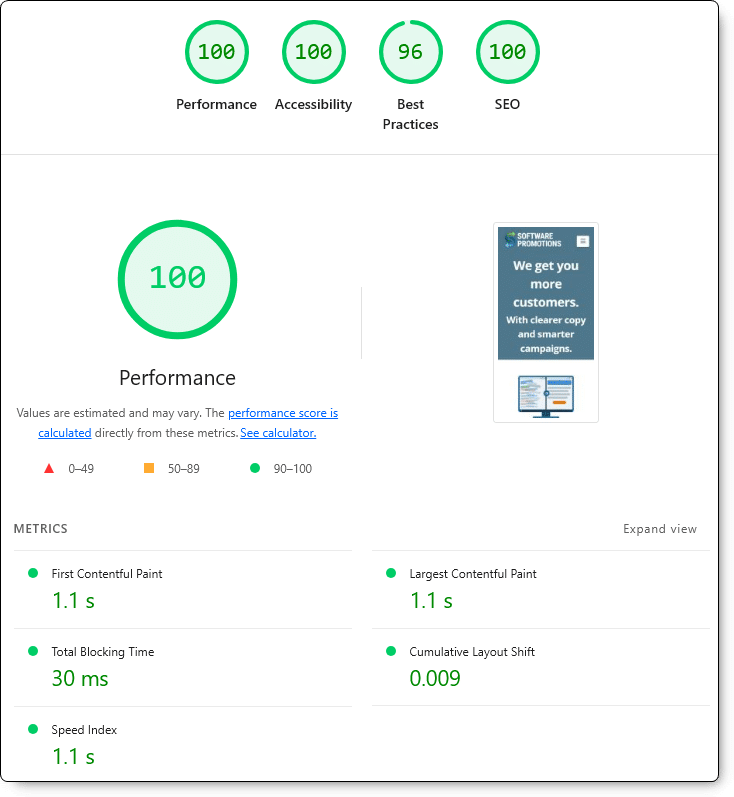
Google have various tools to measure and analyse a page’s speed and performance.
PageSpeed Insights give you an easy to read score for performance, accessibility, best practices, SEO and Agentic Browsing:
Lighthouse, accessible from within a Chrome based browser is similar:
Use these tools and figures as a guide, not gospel.
If you run two consecutive tests, you often see a slightly different score.
And remember that Google have their own political reasons for pushing ever-higher scores.
Going from 40 to 80 on mobile is worth doing. Going from 82 to 85 isn’t.
Quick actions:
- Prioritise Core Web Vitals: LCP, INP, CLS.
- But don’t obsess over it!
- If possible, compress and properly size images, defer non-critical JS, and lazy-load below-the-fold content.
Realism wins over optimism
A lot of small business permanently have SEO on their “get round to it one day” list.
Realistically, that probably means it’ll never happen.
If you can only do one single SEO task right now, start with the Google Search Console.
Then work your way down the list.
The speed of doing this doesn’t matter. Doing anything is infinitely better than doing nothing.
The other eighty percent
Then there are the other SEO tasks, some of which you may be doing or at least considering.
Note that the list isn’t exhaustive.
These are only some of the things you can do.
The important point is that for most people, these won’t make any difference at all.
Some of them can even do you harm.
If you’re spending a significant amount of time on something here while ignoring the six above, you’ve probably identified a means of saving some time and effort.
- Pushing PageSpeed from 80-85 to 90+.
- Chasing a 100/100 score on any SEO tool.
- Rewriting meta descriptions to boost rankings.
- Redesigning pages that already rank well.
- Bolting an FAQ block onto every page for SEO.
- Creating SEO content that ultimately doesn’t deserve to rank highly.
- Trying to get a featured snippet for every query.
- Hitting a word count.
- Chasing a keyword density percentage.
- Pumping out more content before improving the ones that are or should be working.
- Going after brand-new, high-competition keywords while your page-two “better” terms just sit there.
- Regularly changing title tags “just to improve things”
- Adding schema everywhere it will never show a rich result.
- Publishing on a fixed schedule for its own sake.
- Reacting to every Google algorithm-update rumour.
- Following any SEO secrets, clever tricks or hacks.
- Checking your main keyword’s rank every day.
- Watching third-party authority scores like DA or DR, which Google doesn’t use.
- Treating your number of indexed pages as a goal in itself.
- Reshuffling your URL structure for SEO.
- Renaming page URLs for SEO.
- Stuffing keywords into content, image file names, image titles and alt text.
- Hunting for “LSI keywords”. Move on if you don’t know what this means!
- Worrying about a duplicate-content penalty (there isn’t one).
- Fixing W3C validation errors for SEO.
- Setting up hreflang when you sell in one country, one language.
- Submitting your URLs to Google.
- Submitting to hundreds of directories. Actually, submitting to any directories, really.
- Hidden, invisible or stuffed keyword text.
- The meta keywords tag. 1990 tactics. Really.
- Writing for the search engine at the expense of the reader.
- Link building.
Most of the above counts as harmless-but-pointless busywork.
Some of them, especially near the bottom, can hurt you.
None of them belong ahead of the six.
The freeing part
Don’t be put off by the number of items that you should be doing.
You don’t have to do all of it.
You can’t do it in a day. You can’t do it in a week, or even a month.
If you decide to work on the full list, take it slowly. A little at a time, spread across a year or more.
“Done slowly” beats never done at all.
Just do the first thing.
Set up Search Console. Look at what it tells you. Then put a note in your calendar to come back in a few months and take the next rung.
That’s 80/20 for SEO.
A small number of things that are actually worthwhile.
Unique ideas for your business
The Demystifier puts practical ideas into your hands. You won't find them elsewhere. Original, actionable and insanely effective.