

I recently decided to cancel my subscription for the software I’m using right now to write this.
The problem wasn’t the software. It did everything I wanted and more.
The problem was I could do almost everything in Claude AI. Paying for two tools was a waste of money.
I was wrong.
The mistake was caused by invisible value. When customers receive but don’t perceive benefits.
This perception gap exists in almost every business I’ve interacted with.
It’s a real problem, and it almost certainly affects yours too.
The competence trap of invisible value
When a product or service works well, the visible value can disappear.
When I first used a satnav in my car, despite its basic functionality and clunky interface, it felt almost magical. It helped me get from A to B without pain.
Today, I’ve been using Waze as my in-car satnav for years.
It’s become the norm, and I no longer appreciate the hours of driving and stress it saves me.
I take for granted that it avoids heavy traffic, warns me of issues that lie ahead, and reroutes me when I fail to follow directions.
The better something works, the less impressive it seems.
When this applies to your business, it can be a devastating problem.
If you don’t highlight that invisible value at the right moments, customers will likely default to price comparison.
The invisibility of electric safety
In my old house, we occasionally had an issue of a circuit breaker tripping. Initially, it was rare, with no discernible patterns, so we put it down to something that would resolve itself.
The tripping became more frequent.
The problem worsened, and I called an electrician.
After basic checks, he decided to open every electrical socket one by one.
He found the culprit: the plug socket next to my young daughter’s bed! When he opened it, it was black and partly melted. As a Dad, I found this terrifying.
When I called the electrician, I thought I was paying to stop the circuit breaker from tripping, but this was just a symptom.
I paid for a safer house and the peace of mind that came with it.
There was a gap between my expectations and the delivery. This exists everywhere: the trades, professional services, software and more.
Hidden software benefits almost lost me
You probably haven’t heard of Lex.
It’s an incredibly useful writing tool.
It’s like Google Docs, but far better.
And one of its greatest strengths is its minimalist interface.
There are almost no distractions when you’re writing, with powerful features unobtrusively accessible.
Here’s what the software looked like at this point in my writing:
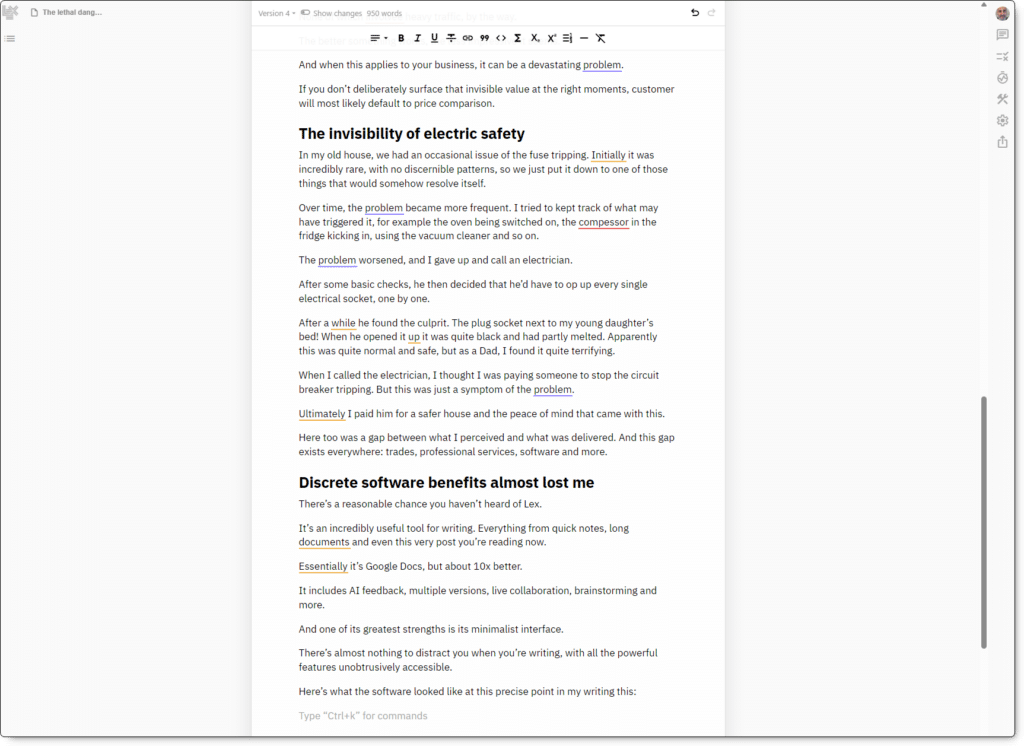
A clean canvas, with the heavy lifting hidden from view.
Which creates a fantastic user experience.
I used it to “chat” about the content, expose flaws or inconsistencies.
I used it to check grammar, spelling, brevity, clichés, readability, repetition and more.

I got too comfortable with the software.
I thought I could get Claude, a tool I was already paying for, to do the same things.
We tried to replicate a single feature of Lex within Claude’s artifacts. It managed the task reasonably well, but took a lot of tweaking to get close to Lex’s standard.
This was only one of 20+ features I regularly use in Lex.
I realised that what looks like a simple checkbox in Lex has real sophistication behind it:
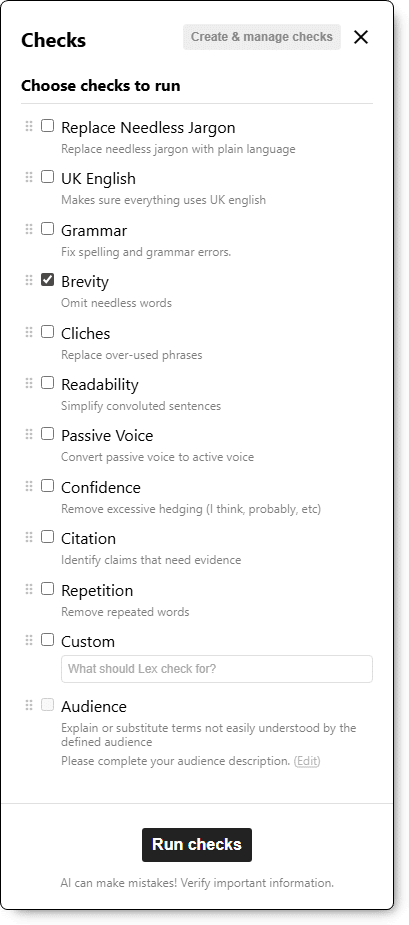
Lex was excellent at hiding their power.
The perception shift here was that I wasn’t paying for an AI writing tool. I was paying for hundreds of invisible checks and useful tools.
The interface’s simplicity hides the power. The seamlessness that makes it good also makes it look expendable.
This is invisibility in action, experienced first-hand.
This situation may apply to your business.
When customers think they may not need your product any more, they might cancel without testing the validity of doing so.
How to solve invisibility by design
I once had an interesting conversation with a funeral director.
A funeral director is a fascinating business.
When I think of their job, I picture someone who handles taking the body in a hearse to the graveyard. The practicalities of death.
The person I spoke to described an issue where after the funeral, many families using his services remarked on how much more he provided than anticipated.
They discovered the process was more peaceful and calmer than expected.
How little friction there was for grieving family members, the ease of navigating legal red tape, managing volatile family dynamics, and acting as a shield against the logistical chaos of death.
They received far more than the practicalities of a funeral.
If his potential customers don’t know they’re getting all that, how long before they choose a cheaper option?
A balance needs to be struck between communicating good value and annoying your customers. And for many, this is easier said than done.
We can all think of companies that have bombarded us with too many emails praising themselves.
I think of this as irritating value theatre.
Even if some of the emails have a small amount of value, my instinct is to unsubscribe.
There are better ways to highlight your benefits.
Our accountants send very occasional newsletters with useful and actionable ideas. For complex topics, they may link to a recorded video or live webinar.
Some of these are useful for me, and even the ones that aren’t remind me they do more than handle our company accounts.
For a software-based example, our business uses various backup products and services.
One of them, Macrium, produces a full image of our hard drives daily. If something goes wrong, we can drop in a new drive and restore the PC to the backed up state.
For me, it’s the ultimate “peace of mind” solution. If my hard drive dies tonight, I’m back in business an hour after replacing it.
We also use Backblaze, which is about as idiot-proof as it gets. After installing the software, every single data file, document, spreadsheet, text file, photo, MP3 and basically every file I have is backed up to their cloud.
Macrium send me a simple log email:
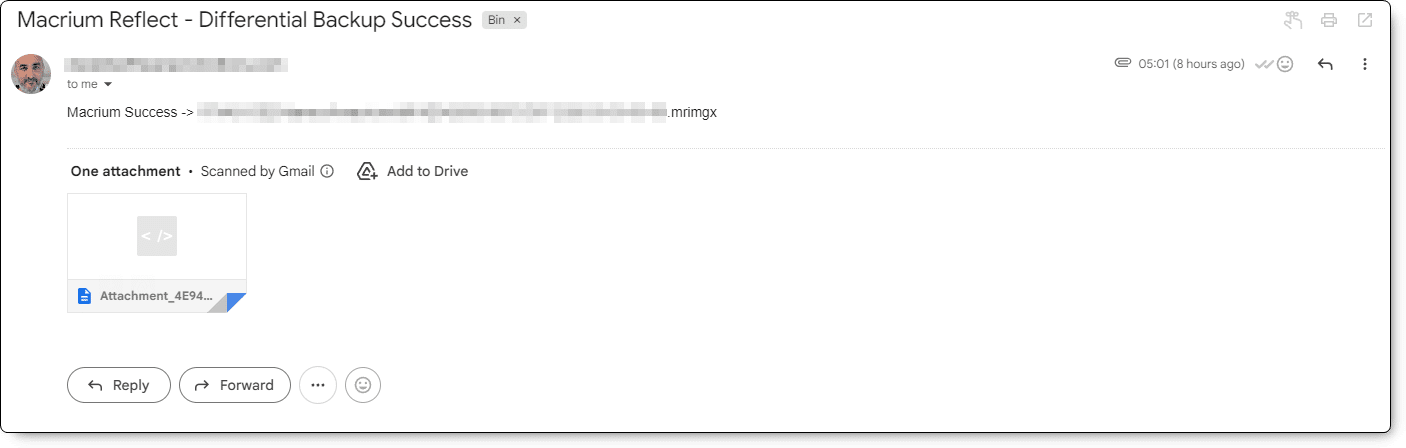
It’s basic, and I may be able to improve it, but it does what I need. It lets me know last night’s backup worked.
Backblaze sends me one email a week:
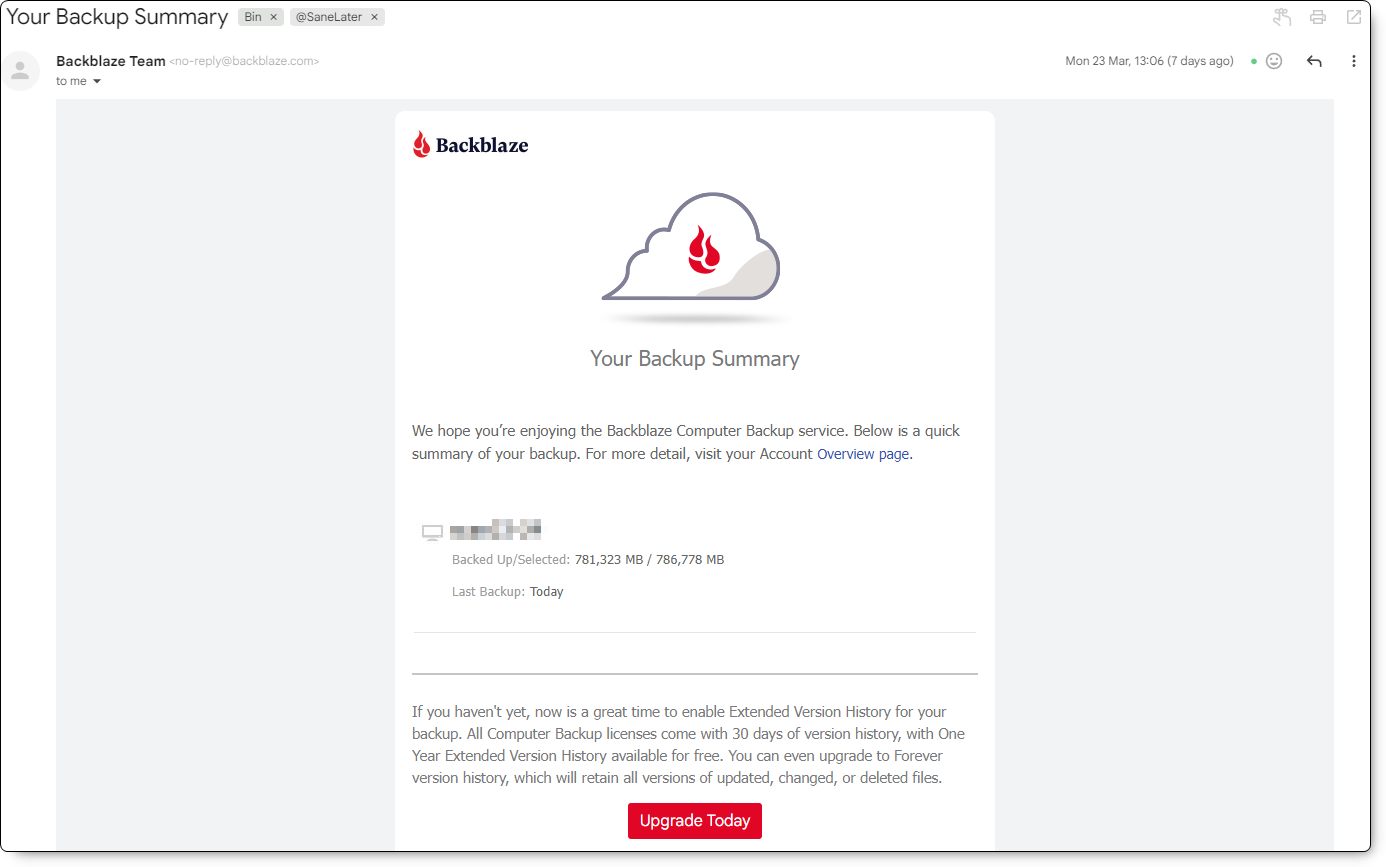
There’s nothing dramatic, but for me, this is excellent.
It reminds me that my backups have been happening in the background all week.
It reminds me that over 781 GB of my data is safe on their systems.
It reminds me I have 30 days of version history.
This is an excellent example of communicating value without interrupting, annoying, or forcing me to do anything more than read an email.
How to eliminate your own invisibility – the process
(1) Identify value and benefits you deliver that customers may not be aware of.
It took me a while to realise my accountant’s emails were useful.
For Backblaze, I didn’t consciously equate the emails with benefits. But I never doubted the value of their service.
(2) Gauge the perception gap. Are most of your customers unaware of the extra value?
While writing this, I realised our company does much more than our clients pay for.
So I’ve added this standard text to the bottom of our monthly invoices:
“We do far more than we charge for.
Conversion tracking, technical fixes, competitor monitoring, website issues, industry trends — much of this is already happening on your account.
Want to know more? Just ask.”
(3) Review your website home page or the specific product/service page. Are any hidden value items mentioned or hinted at?
Consider something like a “What you won’t see (but benefit from)” box with 4–6 bullet points.
Maybe include timelines or checklists for stressful journeys (e.g., funerals, house moves) so people know what you shield them from.
(4) Choose the right moment and method to communicate your value. Options include during product use, at natural touchpoints, or when sending an invoice. Try to avoid interruptions.
In-product: a gentle weekly banner (Along the lines of “Safe since last check”).
Post-service: a summary email with 3 concrete outcomes you achieved.
Invoices: one-line “quiet wins,” not a feature dump.
(5) Keep it simple and reassuring. Raise awareness quickly and unobtrusively.
Think Backblaze, not feature-dump emails.
The first step in visibility is seeing the shadows
Remember the funeral director from the start?
Every funeral director is hired to handle the logistics of a death.
I hope they all fulfill this function.
The funeral director I spoke to seemed to offer a high level of service that went beyond handling the body and burial.
Their problem is that when people seek a funeral director, they aren’t looking for a caring, experienced and adept service. Someone skilled and experienced to handle any situation, no matter how complex or emotional.
They search for an undertaker or funeral director.
If his website doesn’t communicate his unique benefits, he’ll be just another funeral director. Presumably with a higher price than some competition.
This principle applies to your business. Both to new and existing customers.
If you don’t communicate your value, it likely won’t be realised.
In the absence of visible value, price fills the gap. Effectively making it appear higher.
Unique ideas for your business
The Demystifier puts practical ideas into your hands. You won't find them elsewhere. Original, actionable and insanely effective.